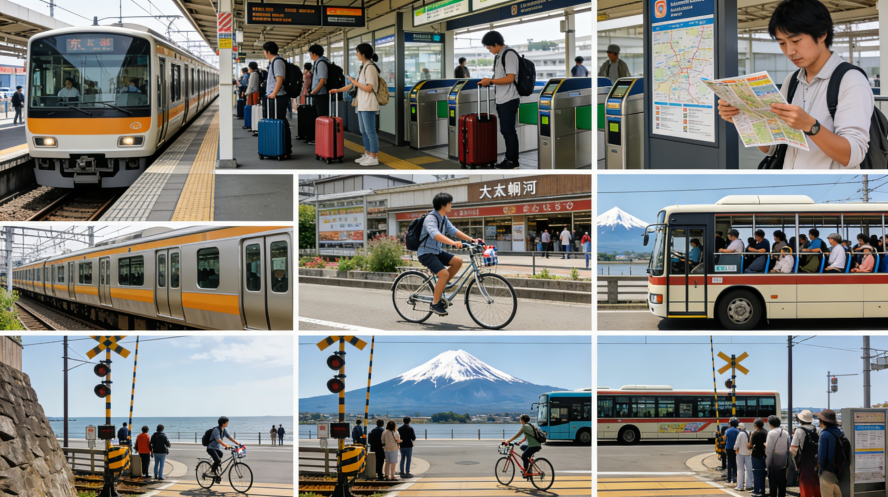
Japan’s trains have a reputation for being fast, clean, and on time, and that part is absolutely true. What can catch first-time visitors off guard is not the quality of the system, but the sheer number of lines, operators, exits, and ticket options in the big cities.
Once you know the “shape” of Japan transport, it becomes reassuringly predictable. Most trips boil down to a few repeatable steps: choose the right line, tap in and out (or scan a ticket), follow platform numbers, and give yourself extra time for large stations. The rest is just practice.
Why rail is the default way to travel
Japan’s main transportation system is its rail network. Trains connect city centres, suburbs, airports, and regional towns with a frequency that makes car hire unnecessary for many itineraries, especially if your route includes Tokyo, Kyoto, Osaka, Hiroshima, Kanazawa, or Fukuoka.
Rail also suits sightseeing. Many attractions are built around station access, and stations themselves often bundle lockers, food halls, shopping, clear signage, and staff who can point you to the right gate or platform.
There are times when a car helps (remote countryside, small islands, some national parks), but for a classic first visit, rail plus the occasional bus or taxi is usually the simplest mix.
The core pieces of Japan’s transport system
In most places you will use a blend of JR lines, private railways, and subways. They can run side by side, even between the same neighbourhoods, which is great for choice and less great when you are tired and just want the “right” entrance.
A helpful mental model is: JR for many intercity routes and major urban lines, private railways for suburban and regional corridors (often to sightseeing areas), and subways for inner-city coverage.
Here are the train types you will see most often:
· Local: Stops at every station and is usually best for short hops.
· Rapid: Skips some stops and is handy for crossing a city faster.
· Limited Express: Fewer stops, higher comfort, often requires a supplement or reserved seat.
· Shinkansen: High-speed intercity trains linking major regions quickly.
The “best” option depends on your day. If you are travelling 20 minutes across Tokyo, speed differences may be tiny. If you are moving between Kyoto and Tokyo, the Shinkansen is the clear winner.
Tickets, gates, platforms: what tourists actually do
Most visitors use one of three approaches:
1. An IC card for everyday city travel
2. Individual tickets for longer rides
3. A pass (national or regional) when the maths works
Japan’s stations are built around ticket gates. You either tap an IC card or insert a paper ticket, then follow signs to your line and platform number. In major hubs, allow time for walking. Some station complexes are effectively small cities.
If you are travelling as a pair, one practical habit is to nominate one person to handle navigation while the other watches the platform screens and keeps an eye on bags. It reduces the “two people doing the same task” problem that leads to missed turns.
IC cards: the simplest daily tool
IC cards (Suica, PASMO, ICOCA and others) are reloadable cards you can use on most trains, subways, and buses, and often in convenience stores and vending machines. For many travellers, an IC card is the single most useful purchase of the trip.
They are ideal for:
· quick tap-on, tap-off travel in cities
· avoiding ticket-machine queues
· small purchases when you want to keep coins under control
One note: coverage is broad, not universal. Rural lines, small buses, and a few regional networks still require separate tickets or cash payment. When in doubt, ask staff at the gate before you enter.
What transport costs feel like (ballpark budgets)
Costs vary by city and distance, and prices can change, so it helps to think in ranges. City trips are usually reasonable, while long-distance Shinkansen days are where your budget can jump.
Below is a practical, tourist-style guide to common expenses. Amounts are indicative only and intended for planning.
|
Trip type |
Typical cost (JPY) |
What to expect |
|
City metro/train (one ride) |
180 to 350 |
Often distance-based fares |
|
City bus (one ride) |
210 to 230 |
Flat fare in many cities |
|
Airport to city by express train |
1,000 to 3,500 |
Depends on airport and service |
|
Short taxi hop (within a suburb) |
900 to 2,000 |
Adds up fast in traffic |
|
Shinkansen medium distance |
8,000 to 15,000 |
Seat type changes the total |
If you are planning a multi-city route, it is worth mapping your long legs first, then fitting your city travel around those bigger numbers.
Shinkansen basics: reserved vs unreserved (and what to choose)
Shinkansen tickets commonly come in reserved and unreserved varieties, with Green Car as a premium option on many services. Reserved seats add certainty on busy routes and peak travel times. Unreserved can be fine on quieter services, but it does introduce a bit of risk if you arrive right before departure during a rush.
If you are travelling with medium to large luggage, reserved seating can also make your day calmer. Some services and periods have baggage rules and designated storage areas, so check when you book.
A simple rule: if it is a key travel day, book seats. If it is a flexible day and you do not mind waiting for the next train, unreserved can work.
Is the Japan Rail Pass worth it?
The national rail pass can be great value, but only when your itinerary uses it heavily within the validity period. Many people buy it “just in case” and then realise their route was better served by point-to-point tickets or a regional pass.
What tends to suit a national pass:
· several long Shinkansen rides clustered into a week
· a loop route that covers multiple regions
· travellers who like spontaneity and do not want to price each leg
What often does not suit it:
· mostly staying in one city with day trips
· flying one long leg (Tokyo to Sapporo, or Tokyo to Okinawa)
· slow travel where long-distance train days are spaced out
If you are unsure, price your top three long-distance rides first. That usually makes the decision clearer than trying to calculate every metro tap in Tokyo.
City transport: Tokyo, Osaka, Kyoto and the “transfer reality”
Tokyo and Osaka have dense networks where “one stop” can still mean a long walk underground. Transfers are common, and multiple operators can share the same station name while having different gate areas.
Kyoto is different. The rail network is useful, yet many sights are bus-linked, and taxi rides can be surprisingly practical when you are trying to visit temples spread across the city.
In any big city, the key is not just choosing the right line, but choosing the right exit. Exits can save or cost you 10 to 15 minutes. If you plan to visit one major sight per morning and one per afternoon, building your routes around the best exits keeps the pace comfortable.
Buses: essential in the right places
Buses are clean and reliable, and they fill the gaps trains do not cover. You will notice buses most in Kyoto, in rural areas, and in scenic regions where the route is the attraction.
Payment depends on the city and operator. Some buses are “enter at the front and pay as you board”. Others are “enter at the rear and pay as you exit”. Signage is usually clear, and drivers are used to visitors, but it is worth watching what locals do for the first ride.
If your day includes buses, factor in a little buffer. Road traffic and weather can affect timetables more than rail.
Taxis and ride services: when they make sense
Taxis in Japan are safe, regulated, and professional. They are also expensive compared to trains and buses, especially for longer distances or when traffic is slow.
They shine in a few situations: a late-night return when trains are less frequent, a short trip with heavy luggage, or a direct ride to a restaurant reservation when you are dressed up and do not want the crowds.
Ride-hailing exists, but it is not the default in the way it is in some other countries. Many travellers simply use taxi ranks or ask a hotel to call a cab.
Airport transfers: a calm start matters
Airport arrival day is when small decisions have outsized impact. After a flight, the easiest plan is the best plan, even if it costs a little more.
Many visitors choose an airport express train or limousine bus, depending on where they are staying. If your accommodation is not near a direct line, consider whether a single taxi from a major city terminal station is worth it to avoid multiple transfers with bags.
If you are travelling as a couple, coordinating an arrival plan before you fly can reduce decision fatigue. Some travellers prefer having airport-to-hotel steps mapped out in advance, including which platform and which station exit, so the first day feels steady rather than frantic.
Common mistakes that waste time (and how to avoid them)
Even confident travellers get caught by a few predictable traps. These are less about “doing it wrong” and more about underestimating how big stations and cities really are.
· Choosing accommodation far from a major line
· Underestimating station walking time
· Packing too many long-distance hops into consecutive days
· Travelling with large suitcases at peak hour
· Assuming every station has lifts on every route
A small adjustment can fix most of these. Stay near a well-connected station, plan one major intercity move every couple of days, and treat transfers as part of the schedule rather than something squeezed in between activities.
Practical habits for a smoother transport day
A few routines make Japan transport feel easy quickly, even if you do not speak Japanese.
· Build a “two-screen” habit: One person checks the route, the other checks platform displays and carriage numbers.
· Use luggage forwarding when it suits: Send larger bags ahead and travel with an overnight bag on Shinkansen days.
· Time your travel: Aim for mid-morning or early afternoon moves to avoid commuter peaks.
Another surprisingly helpful habit is to screenshot key details before you enter the underground. Station Wi Fi and mobile reception are usually good, but having your platform number and line name saved reduces the chance of stopping in the middle of a busy corridor.
How tailored planning can reduce transport stress
Independent travel in Japan is very doable. The challenge is not capability, it is time. Route choices, pass value, station exits, and transfer-heavy days can take hours to research, and the “best” plan depends on your pace and priorities.
Some travellers prefer having their transport mapped as part of the itinerary, including which lines to use, which stations to target, and when a taxi is worth it. Three Bears Travel, for example, designs private, tailor-made trips for two with transport steps built into the day-by-day plan, so you spend less time second-guessing and more time enjoying the places you came to see. That can be especially useful for first-timers, shorter stays, or multi-city routes where a few smart choices save a lot of friction.
A simple way to choose what to book before you fly
You do not need to pre-book everything. You just need to pre-book the parts that protect your comfort.
Many visitors do well with this approach:
1. Lock in accommodation near stations that suit your route.
2. Decide on your long-distance legs (Shinkansen, limited express, flights).
3. Choose whether a national or regional pass makes sense, or skip passes entirely.
4. Plan airport transfers and your first evening’s dinner area.
5. Use an IC card for daily city travel and keep the rest flexible.
Do that, and Japan’s transport system stops being a puzzle and starts being what it is meant to be: a reliable tool that quietly carries you from one memorable meal, garden, museum, market, or mountain view to the next.