
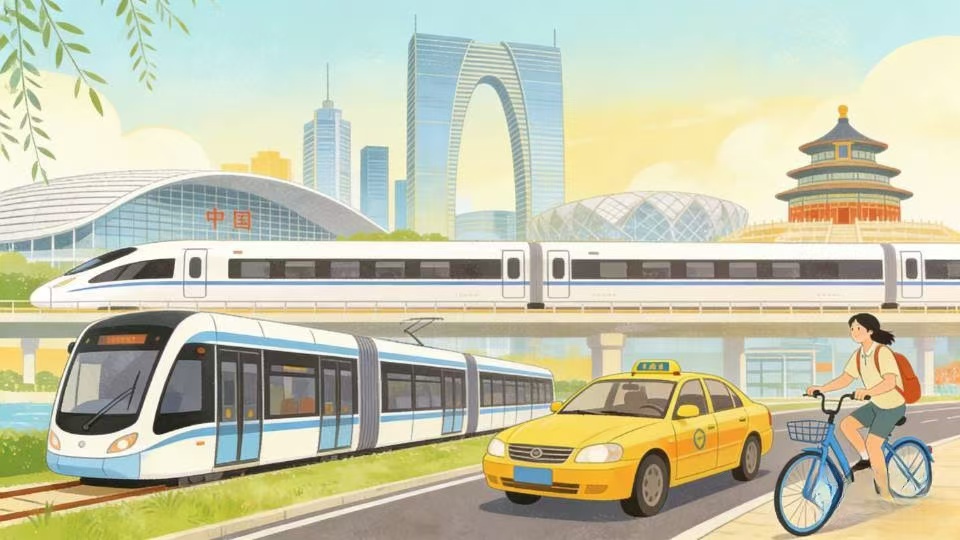
China can look huge on the map, and it is. The good news is that getting around is usually simpler than people expect. China transport is built for moving big numbers of people quickly, with modern stations, frequent services, and excellent value once you know which option suits each leg of your trip.
If you are visiting for the first time, the key is to treat transport as part of your itinerary design, not an afterthought. Pick the right “backbone” for intercity travel, then choose a simple mix of metro, walking, and occasional rides within cities.
What is the main transportation in China?
When travellers ask, “What is the main transportation in China?” the most practical answer is: rail and urban public transit.
China’s cities are designed around metros, subway systems, and buses, and the distances between major sightseeing areas often suit public transport better than driving. Between cities, high-speed rail connects many of the places first-time visitors want to see, with stations that are usually closer to city centres than airports.
Most visitors rely on a combination of:
· High-speed trains
· Metro systems
· Domestic flights (only when distances are very long)
· Taxis or ride-hailing for door-to-door trips
Private cars are common for locals in some areas, yet for visitors, a car is usually only helpful for countryside days, remote scenic spots, or when you want everything handled in a set plan.

Public transport in China: is it easy for foreign travellers?
Public transport in China is generally straightforward in major cities, especially if you stick to metro lines and keep your destination written in Chinese for the occasional taxi ride.
In Beijing, Shanghai, Guangzhou, Shenzhen, Xi’an, Chengdu, and Hangzhou, you will see clear station signage, colour-coded lines, and announcements that often include English. Ticket machines commonly have an English option and now include the ability to purchase tickets using a QR code. Many travellers find that after one or two rides, the metro feels familiar.
There are still a few “first-timer” frictions: busy interchanges at peak times, security screening at metro stations in some cities, and the learning curve of payment apps. None of these are deal-breakers. They just benefit from a bit of preparation.
Metro systems in major Chinese cities
Metro networks are one of the easiest wins for first-time visitors. They are fast, cheap, air-conditioned, and usually predictable even when the roads are choked with traffic.
A handy approach is to plan sightseeing by metro line and cluster attractions. If you are staying near a central station, you may only need a taxi a couple of times across your whole city stay.
If you are travelling as a pair, it can also be nice to choose accommodation within an easy walk of a metro station so you can head out early, return for a break, then go back out for dinner without fuss.
Buses and taxis: when do they make sense?
City buses can be excellent value and reach areas the metro does not. They can also be harder for visitors because route changes and stop names are less consistently shown in English.
Taxis and ride-hailing services, such as Didi, fill the gaps. They are best when you have luggage, you are out late, or your destination is awkward by public transport.
A simple rule is: metro for most daytime sightseeing, taxis for convenience moments. If you prefer things to feel “pre-sorted”, many travellers choose pre-booked transfers on arrival and departure days, then rely on the metro in between.
Here are a few practical moments when cars are worth it:
· Airport arrivals: long walks, crowds, and jet lag make door-to-door transfers feel easy
· Evenings: fewer decisions when you are tired
· Hard-to-reach dining spots: especially if you want to try a restaurant in a residential area
· Bad weather: heavy rain can turn a simple trip into an effort
China bullet train: the fastest way to travel between cities
The china bullet train network is one of the big reasons first-time visitors often leave feeling confident about travelling independently. Services are frequent on popular routes, stations are well organised, and the ride itself is comfortable.
High-speed rail also has a very practical advantage: it is often downtown-to-downtown. You arrive at a city station, not an airport an hour away. That can save time even when the flight looks faster on paper.

How fast is the Chinese bullet train?
If you are searching “How fast is the Chinese bullet train?”, the short answer is: most high-speed services run around 300 to 350 km/h on the main corridors, with some routes operating at slightly lower speeds depending on the line and terrain.
The speed is only part of why it works so well for travellers. The experience tends to be smoother than flying for medium distances:
· Less time spent travelling to far-out airports
· Simpler boarding once you understand the station flow
· More flexible luggage handling than many airlines
· A comfortable ride that still lets you see the landscape change
If you are planning a multi-city trip, high-speed rail often becomes the “spine” that holds the itinerary together.
Why the bullet train is so popular with tourists
Trains are popular because they are dependable and straightforward once you know the basics: arrive early, go through security, find the right waiting area, then board when your gate opens.
Seat classes are easy to compare. Second Class is comfortable for most travellers. First Class gives you a little more space. Business Class is a premium option on some routes if you want extra room and quiet.
A few classic routes that work well for first-time visitors include Beijing to Xi’an, Shanghai to Hangzhou, and Chengdu to Chongqing. These are the types of legs that often feel quicker and calmer than flying, especially once you count transfers.
What’s the best way to get around China?
People often ask, “What’s the best way to get around China?” The most reliable answer is a mix: high-speed rail between cities, metro within cities, and a private car only when you truly need it.
To make that easier, it helps to match each transport type to the job it does best.
|
Travel need |
Best option |
Why it works well |
Watch-outs |
|
Between major cities (2 to 6 hours apart) |
High-speed rail |
City-centre stations, frequent departures, comfortable seating |
Busy stations, arrive early for security |
|
Very long distances (cross-country) |
Domestic flight |
Saves time when rail would take most of a day |
Airport transfers and delays can add time |
|
Daily city sightseeing |
Metro |
Cheap, fast, English signage in big cities |
Crowds at peak hour, station security lines |
|
Late night or luggage days |
Taxi or ride-hailing |
Door-to-door, reduces decision fatigue |
Need destination in Chinese, traffic can be heavy |
|
Scenic areas and countryside |
Private transfer or guided day trip |
Flexible timing, fewer changes, easier access |
Costs more than public transport |
If you are building your own plan, start by plotting the intercity legs first. Then choose hotels that reduce backtracking. Even a small change in hotel location can save you multiple taxi trips.

Booking and tickets: what to expect as a visitor
China’s transport is modern, yet ticketing can still feel unfamiliar. Train stations are large, security checks are standard, and names can be confusing if a city has multiple stations, but using a QR code for ticket access can streamline the boarding process.
A few practical tips reduce stress a lot:
· Know your station name: many cities have more than one major station
· Arrive early: especially for high-speed rail, allow time for security and finding the gate
· Carry your passport: it is commonly needed for ticket collection and station entry
· Keep addresses in Chinese: your hotel can help, or save screenshots in your phone
Travellers who want transport sorted end-to-end often use a planner or tour designer to lock in train times, connections, and transfers in advance. For couples travelling together, private planning can also avoid compromises around pace, start times, and how busy each day feels.
Is China transport foreign-friendly?
In most places tourists go, yes. China transport has become far more accessible for international visitors over the past decade. Major airports and train stations usually have clear wayfinding, and staff are used to assisting travellers who do not speak Mandarin.
You will often see:
English on signage in large hubs Staff used to checking passports and helping at gates Apps and mapping tools that work well in big cities (once set up)
The part that can still trip people up is the combination of scale and small details: finding the correct entrance at a massive station, matching the right train number, or handling a tight connection when you are unfamiliar with the layout.
This is also where having local support can feel valuable. Companies like Three Bears Travel design private, tailor-made trips with transport planned in advance, including the right train classes, realistic transfer times, and on-the-ground help when plans change.
Practical mini-plans that work well for first-timers
A first trip often feels best with a small number of bases and easy rail legs between them. You do not need to see everything. You need enough time in each place to enjoy it.
Here are three patterns that tend to suit first-timers:
· Classic cities: Beijing, Xi’an, Shanghai connected by bullet train
· Food and culture: Shanghai with side trips by rail to nearby water towns and Hangzhou
· West China sampler: Chengdu plus a fast train to Chongqing, with a day trip to nature spots by car
If you are travelling as a pair, these “mini itineraries” can be a smart way to get variety without spending half your trip packing and checking in.
Quick FAQ: China transport for travellers
What is the main transportation in China for tourists?
For most tourists, the main options are high-speed trains between cities and metro systems within cities. Add taxis, Didi, or ride-hailing when you want door-to-door convenience, and flights only for very long distances.
How fast is the Chinese bullet train?
Typical operating speeds on main high-speed routes are around 300 to 350 km/h. Door-to-door time often beats flying on medium-distance routes once you include airport transfers and waiting time.
Is public transport in China suitable for foreign travellers?
Yes, particularly in major cities. Public transport in China is clean and well marked, and metro systems often include English signage. The main challenge is learning the station flow and having destinations saved in Chinese for taxis.
What’s the easiest way to get around China?
For first-time visitors, the simplest approach is bullet trains between cities, metro for daily sightseeing, and pre-booked transfers on key days (arrivals, departures, and countryside excursions). This keeps things efficient while still leaving room for spontaneous stops and meals.